
the full picture
What to expect when we work together
It can be a big step, deciding to let someone into your home to help with what can sometimes be a stressful or difficult situation. So we've put together answers to the questions we're most often asked, in the sincere hope they help you understand what to expect.
And if you have any other questions, or suggestions, please let us know.
three minutes, if you'd rather watch
The same picture, as a short film
We did our best to summarise what to expect in this short film. We hope you enjoy it, but please also feel free to read on to explore in more detail.
on the day
What time will Kari arrive?
The same goes for you: once Kari arrives, you have her full attention, and she doesn't rush off to be on time for the next person.
If an exact start time matters to you, tell us when you book. Maybe you have work, school pick-up or a carer visiting, or you'd just feel easier knowing. We'll plan the day around it and do our best to be there on time, and if we're running late we aim to let you know as early as we can.
Your hours start when we arrive, so a window doesn't cost you any time.
Does Kari make things for my home?
the time it takes
How long will it take?
Clutter is a pile of hidden decisions, and finding out what's really in it is the work itself. We expect effort estimates to vary as we progress and we learn how best to work together to accommodate your needs.
What we bring: our best effort to work with you to create a tailored approach prioritising what is most important to you, your loved ones and your home.
If you'd like certainty, give us a budget and we'll do our best to make the most of the time inside it. Any time guess we give is there to help you plan, so please hold it loosely.

Can we go faster?
If there's a deadline, tell us and we'll do our best to plan the fastest sensible route and price it before you book.
But organising has a maximum speed we won't normally go beyond: see the maximum useful speed, further down.
Longer sessions also go further for the same hours: the why is on how to get the most out of working with us.
Why does it look messier in the middle?
That's not mess; it's normal progress. Often the room is not finished at the end of a session, in which case, we always aim to leave everything as safe and tidy as possible.
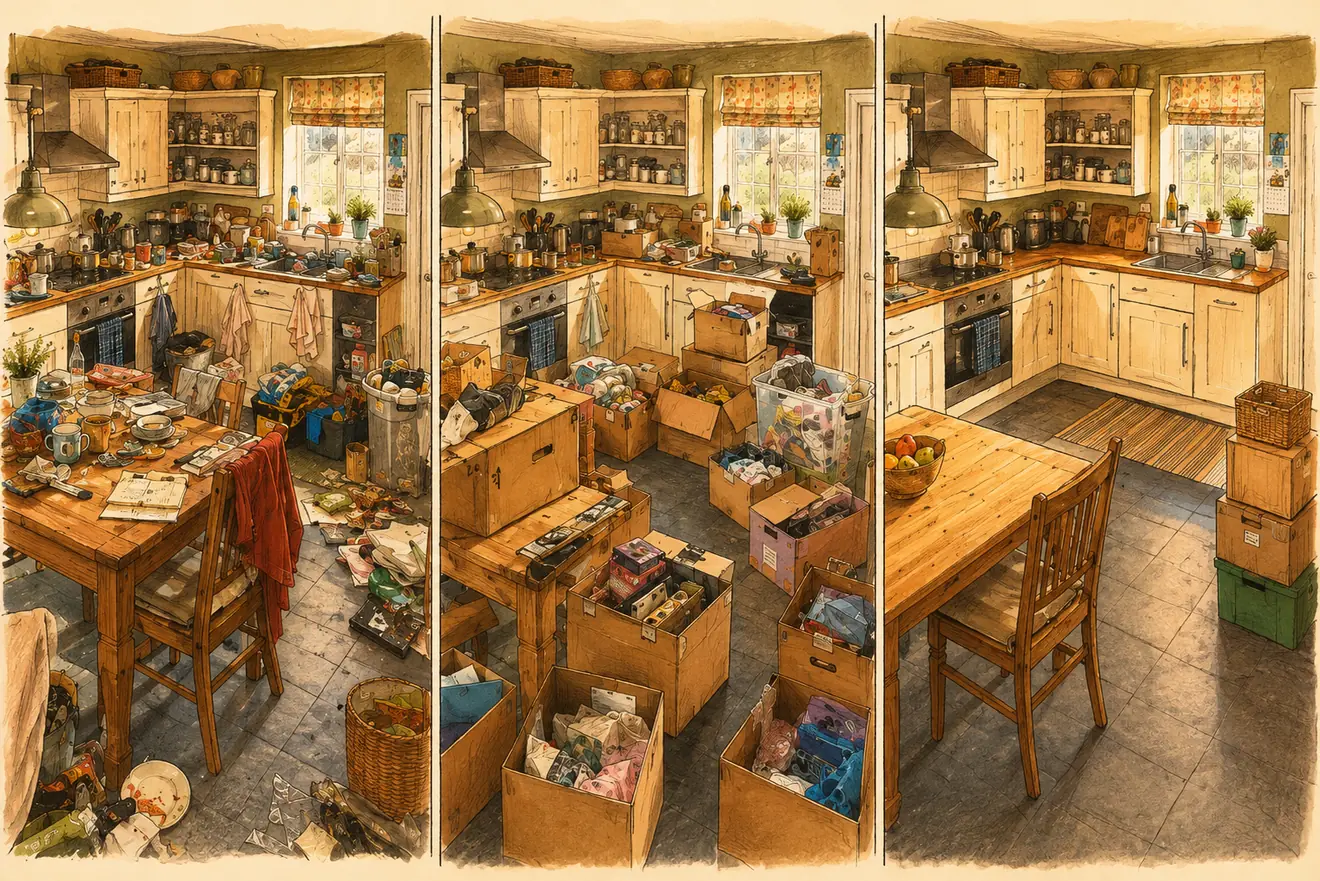
Why one area at a time?
Breaking tasks into small manageable chunks will usually maximise chances of a more sustainable momentum. A smaller but visible achievement feeds motivation and can bring a surprising amount of relief, satisfaction and hope, even if it's not perfect and there may still be a lot to do.
So we usually ask which room, and which spot in it, would bring most relief and we'll start there.
your things, your say
Your decision about your things
How much deciding you want varies. Some people would happily wave the lot goodbye; for others, almost everything holds a story. Both are fine.
And one more thing: we're human, and in a very full home mistakes can happen. The more involved you are, the better chances of everything landing where it should.
How do we keep in touch during a session?
Most important of all: you can't offend us, if something feels even slightly wrong, please tell us immediately.
the practical bits
Why do you take photos?
If something unexpected turns up, we may photograph that too so we can show you what we found. All photos are private working records: you can see them any time, and they are not shared without your explicit approval.
If photos feel uncomfortable, tell us and we'll see if we can find ways to accommodate or not.
And a word on what photos are: they help us track progress, especially in a very full home, but they can't capture everything, so they're an aid to the work rather than a guaranteed record of every single item.
What about money?
Our 20% community commitment: We are committed to providing 20% of our service capacity at a 20% discount to help those that need help with paying. At time of writing we have a waiting list to join our community slots so this is on a best endeavours basis.
Also please see our help with paying page.
What about pets? And who is Wednesday?
Your pet is part of the plan from the start, not something to shut away while we work. If they'd rather be somewhere quiet, that's their choice and we respect it. Their corner is often the easiest place to begin: the food bowl, the bed, the lead by the door. Kari has been known to make a cupboard label with your own pet's face on it.
Wednesday is Kari's dog, a small chug with strong opinions about who she likes. In Kari's words: "my favourite creature, my doggy Wednesday... someone who always improves my mood." She comes along to a session only when a client asks for her. It's for them, not for us: we only suggest it ourselves when we've learned that someone loves dogs and think she might be good company for them, and even then it's their call. Before she first comes, Kari asks about allergies and anyone who would rather not have a dog around. Wednesday isn't a therapy dog, and we don't call her one. What we've seen when someone welcomes her: she settles on a lap, gives doggy kisses, and the person's mood tends to lift.

the person who turns up
How is this different from hiring a cleaner?
She spent four years as an NHS Lived Experience Professional and two as a Recovery College peer trainer, supporting people by drawing on what she'd lived through, and that's exactly how she works in your home: not an expert arriving to fix you, someone who gets it, working beside you. It's why we say please don't tidy first, and why what we find is met without judgement.
Will Kari talk about her own struggles?
For Kari, recovery isn't a finish line, so it's not just "I have been there", sometimes it's literally "I'm here right now".
Do I need to tidy up before you come?
And there's a stranger, truer thing underneath, best said in Kari's own words: "The worse it is, the more I like it: the more satisfying, the more you see the progress. So it's not just that I don't judge. I truly enjoy it. Decluttering and organising a house that's already spotless? For me, that's boring." New clients don't tend to believe this at first. Then they watch how happy she is in the thick of it, the penny drops (one client put it best: "so you really do like this gleaming disgustingness"), and that's usually when people relax.
Is there anything you don't do?
the accelerator pedal
There is a maximum useful speed
When the job is genuinely organising a home, there is a maximum speed beyond which this will start to cause more harm than good. That's when there's no more time for sorting and things just get moved around. This simply delays the organising and will usually make it harder to do later and overall more work.
We commit to doing our best to not knowingly do harm to our clients or their homes.
However your home got to where it is, it got there for a reason, and it can change.
You deserve a clean and calm home.