
Lived experience means knowing something from having been through it yourself, and peer support means help from someone who has been through something similar, as equals. Karina Barboza (Kari) brings both to hands-on decluttering and home support.
This page explains both ideas in plain words, then shows how they shape Kari’s work in your home. Where Kari has already said something in her own words, we quote her exactly.
What “lived experience” means
You can know about a thing because you have studied it. Or you can know it because you have lived it. The second kind of knowing is lived experience.
Take low mood. Anyone can learn about it from books. A person who has been through it also knows it from the inside: what a hard morning looks like, what helped, what quietly made things worse.
In mental health services, lived experience is treated as a real kind of expertise. A Lived Experience Professional is someone employed because of their own experience of mental health difficulties, as well as their training.
Peer support is help from someone who has been through something similar. Peer means equal standing, so the help passes between equals rather than between an expert and a patient.
In the NHS, peer support worker is a paid role. People are employed on the strength of their own experience of mental health difficulties, and the role comes with training and clear boundaries. A Recovery College is a related idea: it runs courses about mental health and recovery, meaning building a life that works for you alongside whatever stays hard. It is set up like a college, so the people who come are students rather than patients, and many courses are taught by people with lived experience.
The heart of peer support is easier to see in four parts. More plain definitions sit in our glossary.
Hope you can see
When life and home feel out of control, and mood is at its lowest, a quiet thought can take hold: nothing can be done. That thought turns up in families, in mental health services, and inside people themselves.
Peer support answers it with a person. Kari has been in that low place too, and she is here now, doing this work: the NHS employed her for four years to support others, and her fellow peer support workers gave her an award for this work in 2025. That is hope you can see, standing in the room.
In her words, from her page for families: “I’ve lived in a home I wouldn’t have let anyone see, during one of the worst depressions of my life. It wasn’t just the flat that was a mess, it was me too. I know how that feels from the inside, and I know how hard it is to ask for help, because it’s still hard for me too.”
The last part matters as much as the rest: it is still hard for her too. This is not a story with a neat ending. What Kari found is that a life that works is possible with practice and time, and she brings that with her into every home.
Someone who has walked the path
There is a difference between advice from a manual and advice from someone who has had to follow it. Picture a mountain path. Kari has walked it herself, so she knows the safe way through, and the places where people get lost. She knows a sound method can still fail on the first try, or the second. And she knows the objections people raise.
The ways of working she shares are the ones that helped her first. So peer support runs on do as I did, and am still doing rather than do as I say. When she suggests an approach, it comes with the weight of practice: she used it, it helped, and she still uses it.
On your side, and not alone

Most help arrives with a gap built in: one person gives it, the other receives it. Peer support narrows the gap. Kari is still doing the same kind of work on her own life that she helps others do in theirs. She walks alongside, and that changes the work.
It is easier to try something when the person suggesting it has had to try it too. And loneliness, which so often travels with these difficulties, has less room. Working beside someone who has been there can bring a quiet, steady thought: I am not the only one.
None of this takes charge away from you. Your home, your decisions. What changes is who is in the room: someone firmly on your side.
Care, all in

Doctors, nurses and therapists are trained to keep a professional distance from the people they treat. There are good reasons for that: distance protects the person receiving care and the person giving it, and it keeps clinical judgement clear. Peer support is a different job.
Kari keeps the boundaries that keep everyone safe, but not the distance. She goes all in. She cares about the people she works with, and she lets the work matter to her.
That costs her, and she would not have it any other way.
Care shown this openly is not read the same way by everyone. Some people, for example some autistic people, read expressed emotion differently, and strong warmth may feel puzzling or too much rather than comforting. Kari knows, and she adapts: how much care she shows, and how she shows it, follows what feels right to each person. The care stays; its shape changes.
Peer support does not compete with clinical care. It offers something different, alongside it.
Kari’s background
Kari spent four years in the NHS at West London NHS Trust, as a Lived Experience Professional and Senior Peer Support Worker, in a Complex Emotional Needs Service and a Community Rehab Team. She spent two years as a Peer Trainer at the Wellbeing & Recovery College, where she taught a course called To Keep or Not to Keep, about decluttering and about why people keep things.
She has trauma-informed training, which means training in how past harm affects people and in ways of working that do not add to that harm. She has also been a trainer at the Anna Freud Centre, a children’s mental health charity. In 2025, her fellow peer support workers gave her the Peer Support Award for Creativity and Innovation.
She holds a current check from the Disclosure and Barring Service (DBS), the standard UK check for people whose work involves adults who may be at risk.
Her own experience of low mood and overwhelm is part of why this work exists. Tidying became her own way of looking after her mental health, and she has made it her mission to help others do the same. In her words, from her About page: “I bring lived experience, trauma-informed training, and a calm pair of hands.” You can read more on the About page.
How it works when Kari comes to your home
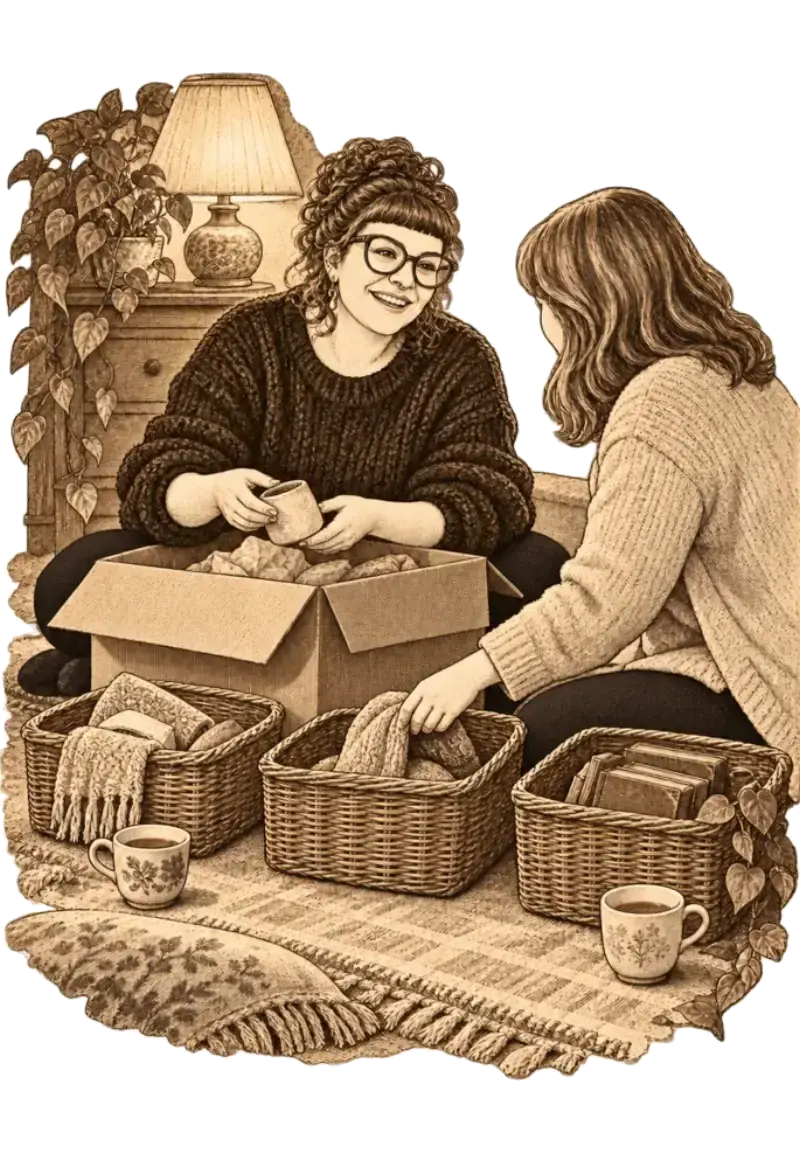
It starts with a free initial consultation: a chance to meet, look around together and talk about what you most want to change. There is no obligation to carry on.
There is no need to tidy first. The rooms can be exactly as they are.
You choose where to start, and you set the pace. Nothing leaves your home without your yes. Kari does the physical work beside you: lifting, carrying, sorting, bagging.
Because her work comes from peer support, she may offer a small piece of what has helped her, if that would be useful to you. The session is about your home rather than her story, and you can ask her to stick to practical matters at any time.
Work moves in small steps, with plans shaped around how you live.
From her page on clutter: “I bring lived experience to the room. We start where you say we start. Your pace, your decisions, your home.” There is a fuller walk-through of a session on our What to Expect page.
What this is not
This is not therapy, counselling or treatment. Kari is not a clinician, meaning she is not a doctor, nurse, therapist or counsellor, and she does not give medical, legal or financial advice.
If part of a job needs a specialist, for example damp, pests or anything unsafe, Kari pauses that area and talks it through with you. Where she can, she points to the type of help that fits.
The work runs alongside any support a person already has, such as a GP (family doctor), a care coordinator (the named person who organises ongoing NHS mental health care, where someone has one) or a therapist. It is there alongside that support, not in place of it.
For advocates, support workers and family members
You are welcome to be part of this work, if the person you support wants you there. The person decides who comes into their home, and that decision stays with them.
The person also stays in charge of every decision about their home, including when someone else arranges the visits or pays for them. If someone else pays, nothing changes about who leads. Our help with paying page explains the options.
With the person’s consent, Kari can send brief progress updates to the people around them: whether visits went ahead, how things are going overall, and any concerns. These are short notes, not formal clinical reports. If you support people in a professional role, there is more detail on the professionals page.
If things feel hard during a session
Any session can be slowed down or stopped, at any point, for any reason. The pace belongs to the person whose home it is. Nothing is wasted by stopping; the work simply waits for another day.
Kari is not a crisis service. If someone is in crisis or at risk, during a session or between sessions, the right places to turn are:
- their GP or care team, during opening hours
- NHS 111 (choose option 2 for mental health), the NHS line for urgent help that is not an emergency
- Samaritans on 116 123, free to call at any hour, day or night, to talk with someone who will listen
- 999, if it is an emergency
Questions and answers
Is Kari a counsellor or a therapist? No. Her background is peer support and lived experience work, with trauma-informed training. What she offers is practical home support with peer support in the mix. It is not therapy and it does not replace therapy.
Do I have to talk about my mental health? No. Sessions are about your home and what you want from it. How much you talk, and about what, is up to you.
Will she tell me about her own experiences? Sometimes, a little, if that helps you. Sharing experience is part of how peer support works, but it is not the main event, and you can ask her not to.
Can my support worker or a family member be there? Yes, if that is what you want. You decide who is in the room.
How did Kari come to this work? Through her own life first: tidying became her way of looking after her mental health. Her NHS work as a peer support worker came next, and Healing Spaces grew out of both. In her words, from her About page: “I left the NHS because I wanted to do this work the way I always thought it should be done. Smaller, calmer, and entirely on the side of the person whose home it is.”
What is a Lived Experience Professional? It is an NHS job title for someone employed to use their own experience of mental health difficulties to support others, alongside their training. Kari did this work for four years at West London NHS Trust. “Peer support worker” and “lived experience practitioner” mean much the same thing.
Is it a course over a set period? What happens at the end? No, it is not a course with a fixed length. After the free initial consultation you choose what suits you: a single session, a half or full day, or ongoing support, and how often. The plan can change as you go. The aim is a home that feels like yours again, and skills that stay with you once the sessions end.
What are DBT and CBT, and how are they different? Both are talking therapies offered by the NHS. CBT, cognitive behavioural therapy, looks at how thoughts, feelings and actions affect each other, and practises changing the patterns that keep you stuck. DBT, dialectical behaviour therapy, grew out of CBT. It adds skills for when emotions arrive fast and big, and the idea that your feelings are real and allowed while you still learn to do something different with them. Kari is not a therapist and does not deliver either therapy. She has learned DBT skills herself and has written about them in our toolkit.
Will it upset Kari if I get overwhelmed in a session? Going quiet, crying, or not being able to find your words can be part of sorting through a home, and Kari knows that from her own life as well as her work. She can slow down, stop for a while, or leave a job for another day, whatever helps you. Nothing you feel or show is met with judgement.
What if Kari is running late? If Kari is running late, she messages you as soon as she knows, with a new arrival time. If she cannot come, she tells you as early as she can and you choose a new time together.
Does this replace the support I already have? No. It sits alongside your GP, care team or therapist, if you have them. It is not treatment.
The first consultation is always free, and there is no pressure to book anything. If you would like to ask a question first, every way to reach Kari is on the contact page.